Showing posts with label Courtship. Show all posts

19 March 2013

Need your daughter protected? Why not spider?


Unlike most humans, spiders usually show little to no parental care.  About the only time you can ever see a spider taking care of their offspring is when a female will guard/egg sace a nest or carry the babies on her back like some wolf spiders. Salticids are no exception to the rule of parental care.  However, when it comes to guarding a mate, there are few creatures more diligent in the invertebrate world than a male salticid.
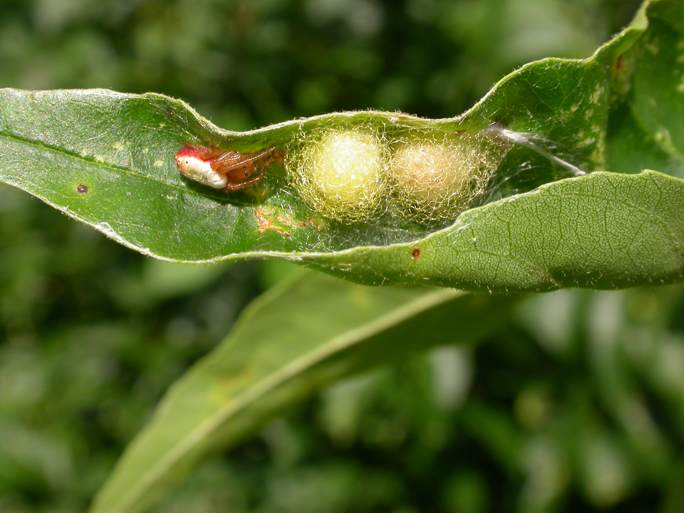

http://www.isledegrande.com/giimages9/spiderwitheggcases.jpg
Spider guarding her eggs sacs.


Mate guarding is not uncommon in the world of spiders, though it is most prevalent in web spinning spiders.  Amongst the cursorial (wandering) spiders, the usual method of mating is to find a mate, inspect them for suitability through the ritualized mating displays, and then mate if they were found suitable.  This whole process can be as quick as a few minutes or as long as several hours.  What makes jumping spiders unusual is that while the males go looking for females, they are often seen hanging around immature females who are physically incapable of mating!

Ok, so a bit creepy from the human perspective, but to scientists this makes perfect sense.  Why?  Well, in many species spider, females will only mate once in their lifetime.  If a male can find a female while she is still a juvenile (and therefore incapable of mating) he can be sure he will be the first to court the female and (ideally) mate with her.

Peacock spiders (Maratus sp.) courting.  The male is the colorful one on the right.

We all know how important it is to find a good mate, but spiders seem to take this to extremes.  Some males, upon finding a female, will build a nest (bivouac) by attaching lines of silk to the female's retreat.  He will then proceed to follow her and "guard" her from other males until she molts to maturity, sometimes many days later.  Once she has fully matured, he will begin the courting process...

Another interesting strategy some males use is to find a female's nest and court her by tapping out a species specific pattern on the walls of her nest.  If she is interested, she will either wait for the male to continue and slowly proceed into the nest, or else she will come out and evaluate the male more thoroughly.  If she is uninterested, the female will often run out of the nest and chase the male away.
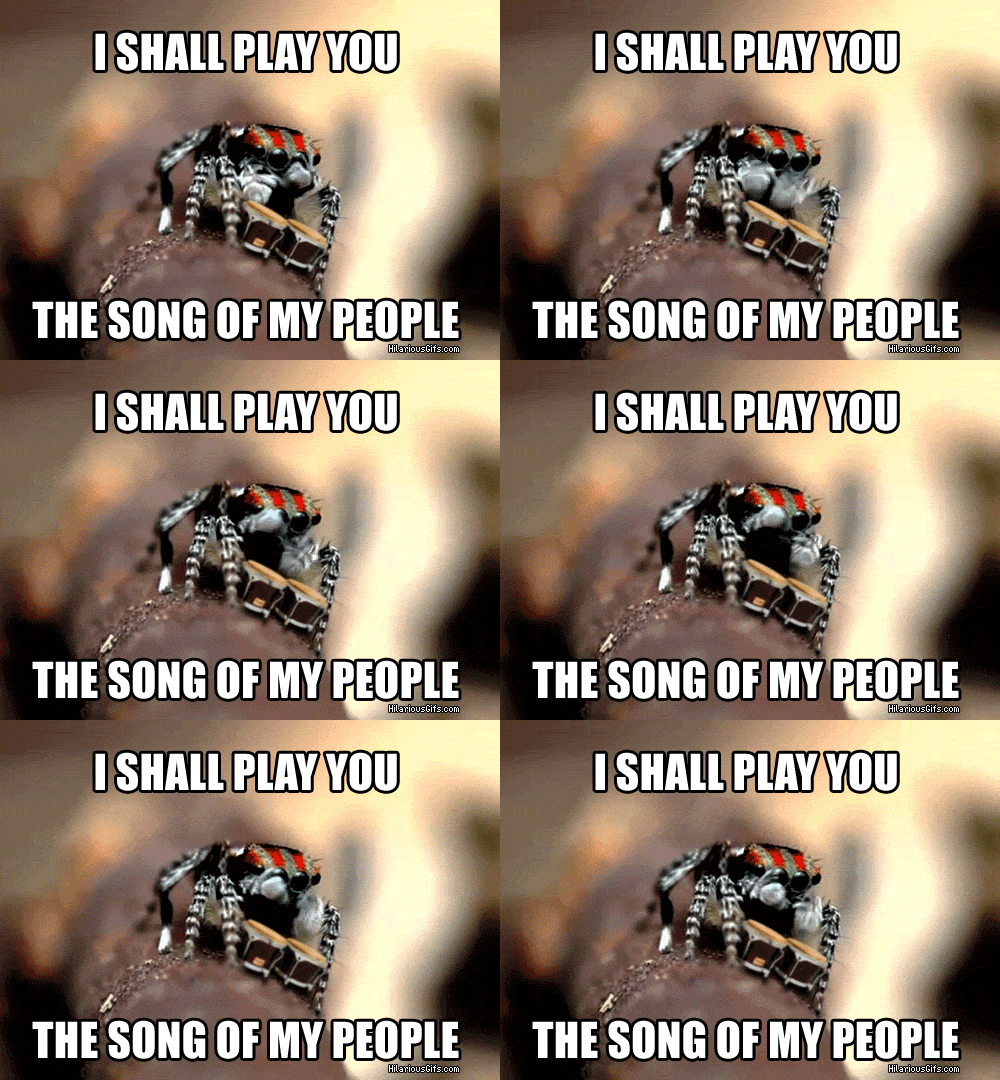


Ok, so the male doesn't really show up with tiny bongos, but it does paint a pretty good mental image doesn't it?  As with all of our posts, if you would like more info on today's topic, we would strongly encourage you to dive into the primary literature.  The early work of Robert Jackson and Damian Elias are both excellent starting places for this area of research.  Finally, we love hearing from our readers and encourage you to post your questions (and comments) in the comment area below.  We will answer as soon as we can! 

09 November 2012

Miniature Mating Rituals

     Imagine a world where your everyday is fraught with danger.  Danger from predators hundreds of times your size.  Danger from your potential food which might try and eat you back, or if you're lucky, is only poisonous.  Imagine a world so dangerous, that even trying to ask a pretty girl out for a bite to eat could result in you being what was eaten.  If you can do all this, then you are starting to understand the world of a jumping spider male on the quest for a mate...


     Jumping spiders have some of the most elaborate and complex mating rituals in the arthropod world.  There are a some really good theories behind this complexity, and in today's post we will discuss a few of them.
     Many male spiders use vibration as a signal when courting an attractive female, and jumping spiders are no exception.  However, unlike many spiders, salticids also have very elaborate visual displays to accompany their vibratory signalling.  When you combine the visual display (signal) and the vibratory display (know as a seismic signal in the scientific community), you end up with what is called a multi-modal signal.  In other words, if you (the signaler) emit a signal over multiple sensory channels (seismic + visual in this case) you can potential provide more information in less time to the listener (receiver).  For instance, the seismic signal could say one thing (ex: I'm a male of your species), while the visual signal could say something else (ex: I'm really fit and attractive!).  However, the cost of sending signals this way include things like increased complexity of the transmission, which also increases the difficulty of sending this signal without making an error.  This idea of increased difficulty is one of the ideas behind a jumping spiders multi-modal courtship.  By using a more complex and difficult to produce signal, the male spider can potentially increase his attractiveness to the female by demonstrating how much more fit he is than his competitors.  To put it in more human terms, think of it as having to choose between a mate who can do push-ups while doing basic arithmatic (ex: 2+2=4) in his head versus a mate who can do as more pushups while also doing calculus (ex: d/dx tan x = sec2 x) in his head.  Pretty easy choice right?

     Another idea (the signal redundancy hypothesis) asserts that these multi-modal signals are not sending multiple pieces of information, but rather the same information two different ways.  The idea here is that if one signal is blocked or poorly received, for instance because the light is poor, then the second part of the signal can compensate for the deficiency. This theory makes a lot of sense when you consider the environments in which some of these spiders live.  Tropical forests, for example, have a patchy light distribution and so a spider may not always be able to signal in the lighting that makes him look best.  In this case, he would rely on the seismic signal to help him impress the ladies.  While he would probably give the best impression in bright light and a nice seismically conductive surface, the males have adapted to being able to signal even under less than ideal conditions.  After all, when the consequences of not impressing a female on the first try include death, you don't want to mess things up when you do find the elusive mate you've been hunting.

Enough with theory, how about some practice?  The video below is an excellent example of multi-modal courtship.  What you will be watching is a male spider courting a female spider.  The female is the one who is pinned in place with wax, while the male is the one moving around and making all of the buzzing and revving sounds.  It does take the male about 30 seconds to really get going, but once he does, he puts on quite the show!


For other examples of salticid courtship, I highly recommend searching youtube for "Jumping spider courtship," there is some amazing footage and even a few amusing remixes on the site.

Happy spidering!