Showing posts with label ID. Show all posts

07 February 2014

Is that a spider-ant or an ant-spider?


Have you ever seen one thing and thought that it looked remarkably like something else, only to realize that it was in fact entirely different from what you thought it was in the first place? Yeah, me too, and usually its because the "something else" was a mimic of the object you initially thought you were looking at the first time.  Confused yet? Good!... Wait, no, bad.  Here, let me try again with some pictures and a quiz! Don't worry, its a simple one.  All you have do to is decide whether each image is an ant or not.

Ready?

GO!

Ant or Not?


Ant or Not?
http://farm8.static.flickr.com/7205/6862094613_64c86b33d4.jpg
Ant or Not?
http://farm6.static.flickr.com/5084/5317864625_4ccd6d2b1c.jpg
Ant or Not?
Done?

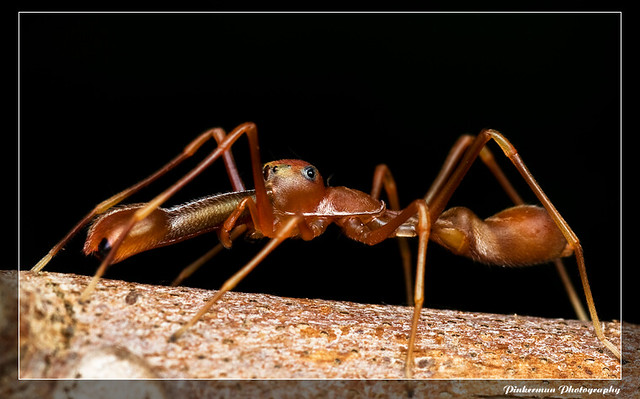
Great! How did you fair?  If you said that they were all NOT ants... you were correct!  That's right, those remarkably ant-like creatures are impostors, and in fact all of them are actually salticids!  Scientists refer to ant-mimicking creatures as Myrmecomorphs (Myrmeco- meaning ant, and -morph meaning appearance).  Myrmecomorphs are found in several different spider families as well as in several other arthropod groups like beetles, flies and assassin bugs. The real question though, is why would you want to look like an ant? The answer might surprise you...

Ants are ubiquitous (everywhere) and as such, they tend to play a disproportionately large role in the environment around them.  Many creatures have specialized to feed on ants, but even more have evolved ways of avoiding ants.  Why would they bother avoiding such a small and seemingly insignificant creature?  For starters, ants can live in very large (>1,000,000 members) colonies that function as a single unit.  This is very evident when they are out foraging (looking for food) in large numbers.  Ants have evolved to swarm and overcome larger objects through sheer numbers. Most ants have also evolved the ability to defend themselves, usually through biting and/or stinging.  Now apply that defensive capability to an entire group of parading ants...


Remember what happened to Gulliver when he met the Lilliputians?

This idea of being swarmed applies to most creatures if they are caught off guard, and therefore they avoid the ants. Think of it this way, one ant at your picnic seems unimportant, while a column of aggressive, hungry ants is a definite problem.  But what if you could take advantage of this quasi-universal avoidance of ants that many creatures possess?  This is exactly the idea behind myrmecomorphy.

Myrmecomorphs are a special type of mimic known as a Batesian mimic.  Batesian mimics are creatures who look like dangerous or harmful creatures without actually being dangerous themselves.  While some of you may not agree that salticids (or spiders in general) are harmless, compared to the power of an ant colony they quite safe, and to my knowledge, there are no medically significant myrmecomorphic spiders. But I digress...

By living under the guise of an ant, myrmecomorphic spiders are able to go places disguised as ants without worrying about predators recognizing them as salticids.  Indeed, a few different studies have shown that predators do not recognize myrmecomorphs are spiders, but rather treat them as they do ants.  However, this also means that predators who specialize on ants are more likely to eat a myrmecomorph than they would be if they didn't look like an ant.  Like so many adaptations, myrmecomorphy is a double-edged sword.

 Myrmecomorphs are fascinating little creatures, especially those in family salticidae.  A lot of research has been conducted on these morphological marvels encompassing things like myrmecophily (living with ants), myrmecophagy (feeding on ants) and mate recognition/distinction as a myrmecomorph. Dr. Paula Cushing has conducted some fascintating studies on this topic.  If you're as fascinated by these tiny "costumed" spiders as I am, you can read her review article here.  It covers a lot of the basics and is a great starting point for future reading.

Happy Spidering!


13 September 2013

Macro-tacular Salticids


Today's long-delayed post is nothing short of a shameless excuse to peruse some of the best Macro-photography on Salticids present on the web.  I will take you on a guided tour of some of the best shots I know of and hopefully even help identify some of what your looking at in the photos.  After all, knowledge only makes things more appealing and interesting! Just by way of disclaimer, none of the following images are mine, and the species labels, while educated guesses, should not be treated a positive identifications as the specimen was not available for me to key out properly.


Our first photo is a lovely close up of a Phidippus species.  This specimen is likely from the species P. mystaceus, given the extremely large black tufts around the eyes and the bright yellow legs.
http://25.media.tumblr.com/tumblr_lvys4wWKLO1r3p20do1_500.jpg
Borrowed from http://25.media.tumblr.com/tumblr_lvys4wWKLO1r3p20do1_500.jpg


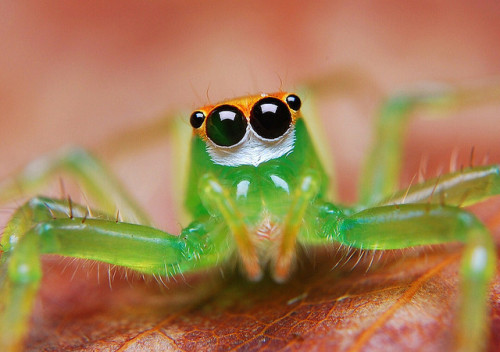
Our next lovely model is almost certainly from the genus Lysomannes as there are very few other salticids with such a bright green complexion.These tiny salticids are known for their ability to jump very well (even for a salticid) and frequently catch flying prey by pouncing on it mid-air as it flies by!
http://24.media.tumblr.com/tumblr_mc8xsb5Oo51rob773o1_500.jpg
Borrowed from http://24.media.tumblr.com/tumblr_mc8xsb5Oo51rob773o1_500.jpg


This lovely ant is... wait a minute, that's no ant, its a salticid in disguise! If you take a very close look, you can see the telltale signs that we have a myrmecomorph (ant-mimicking spider) on our hands! While I am unsure as to the species, or even the Genus of the animal, I think we can all agree that it does a remarkable job of looking like its intended victims. Many species that adopt this form of mimicry feed on ants and even live in the nests of those they hunt.  However, there are also mimics that only use the ants for protection and either steal food from them or else specialize in foraging near ant lines and colonies.  A fascinating way to outsmart one of the salticids most dangerous enemies!
http://farm5.staticflickr.com/4149/5050635255_aa3abe82a8_z.jpg
Borrowed from http://farm5.staticflickr.com/4149/5050635255_aa3abe82a8_z.jpg


Our final red-faced friend is from the Genus Habronattus.  The photographer has identified the animal as H. americanus. Habronattus are generally tiny animals and are frequently no more than a few millimeters in length. They are also quite adept at jumping, much more so than this counterparts in the genus Phidippus.
http://bugs.adrianthysse.com/wp-content/uploads/2013/08/Habronattus-americanus-21-04-2013-5-31-36-PM.jpg
Borrowed from http://bugs.adrianthysse.com/wp-content/uploads/2013/08/Habronattus-americanus-21-04-2013-5-31-36-PM.jpg


I hope you've enjoyed this brief macro tour of salticids.  For the next post, I'm planning something a bit more meaty in terms of content, but every so often its nice to have fun with these beautiful animals.  As the Summer draws to a close, I encourage you to go out and enjoy these amazing little animals one last time before winter sends them scurrying for a long, and undoubtedly well deserved, nap.Happy watching!

15 January 2013

How to ID a jumping spider


While the topic has been talked about obliquely, it seems time we came out and said it directly.  How, exactly, do you know if you have found a jumping spider or not?  The easiest way it to simply look at its eye arrangement.  If it is a jumping spider, it will have two very large eyes in the center of its face, flanked by another slightly small pair.  The picture below is an excellent example of a male Phidippus audax.


File:Phidippus audax male.jpg
http://en.wikipedia.org/wiki/File:Phidippus_audax_male.jpg

 However, if you prefer not to get quite that close or lack a hand lens to help you see the eyes, we have hammered out a few rough rules below that should allow you to ID them anyways. 


DISCLAIMER: These rules are guidelines only!  Like much of science, there will be exceptions to rules such as these, no matter how carefully crafted.  Please also keep in mind that these rules, while very general, are also focused mainly on the salticids of North America.  The tropics will have exceptions to most, if not all, of these rules.


Rule 1: Where was the spider found?
    a) On the ground - Maybe a salticid, see rule 2
    b) On a vertical surface like a wall - Maybe a salticid, see rule 3
    c) In a web -  probably not a salticid, but see rule 4

Rule 2: When you walk up to it, how does it move?
    a) Jumps! - probably a salticid
    b) Runs away very fast - most likely not a salticid

Rule 3: If you wave your hand near/over it, what does it do?
    a) Turns to face your hand, or where your hand came from - Salticid!
    b) Runs like heck! - probably not a salticid

Rule 4: What is the spider doing in the web?
    a) Building the web - NOT a salticid
    b) Feeding on another spider -  Maybe a salticid, see rule 5.

Rule 5: What do the legs look like?
    a) Very long and spindly - Not a jumper
    b) Proportional to the body size - probably a salticid

Rule 6: If capture and put in a container (NOT airtight!) for a day or two, what does it do?
    a) Builds a tiny silken sleeping bag - Salticid!
    b) Builds a traditional web - not a salticid
    c) Stays on the bottom of the container and cannot seem to climb the walls - not a salticid


If you think you have found a jumping spider, we encourage you to Google the animal's description.  As jumping spiders are so very colorful, and often uniquely patterned, you can often find the specimen your looking for without too much trouble. One great resource for this type of searching is Bugguide.net.

Just remember, that when in doubt, always err on the side of caution and contact an expert to help you identify the spider.