Showing posts with label Photo. Show all posts

13 September 2013

Macro-tacular Salticids


Today's long-delayed post is nothing short of a shameless excuse to peruse some of the best Macro-photography on Salticids present on the web.  I will take you on a guided tour of some of the best shots I know of and hopefully even help identify some of what your looking at in the photos.  After all, knowledge only makes things more appealing and interesting! Just by way of disclaimer, none of the following images are mine, and the species labels, while educated guesses, should not be treated a positive identifications as the specimen was not available for me to key out properly.


Our first photo is a lovely close up of a Phidippus species.  This specimen is likely from the species P. mystaceus, given the extremely large black tufts around the eyes and the bright yellow legs.
http://25.media.tumblr.com/tumblr_lvys4wWKLO1r3p20do1_500.jpg
Borrowed from http://25.media.tumblr.com/tumblr_lvys4wWKLO1r3p20do1_500.jpg


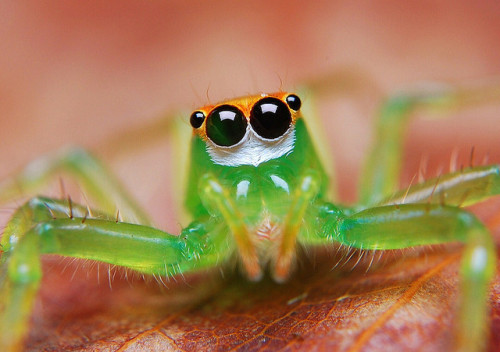
Our next lovely model is almost certainly from the genus Lysomannes as there are very few other salticids with such a bright green complexion.These tiny salticids are known for their ability to jump very well (even for a salticid) and frequently catch flying prey by pouncing on it mid-air as it flies by!
http://24.media.tumblr.com/tumblr_mc8xsb5Oo51rob773o1_500.jpg
Borrowed from http://24.media.tumblr.com/tumblr_mc8xsb5Oo51rob773o1_500.jpg


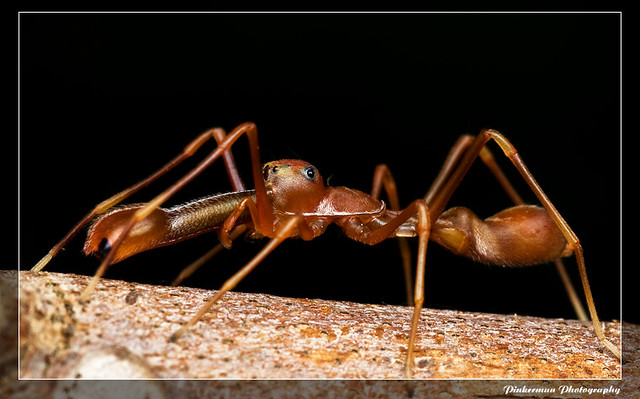
This lovely ant is... wait a minute, that's no ant, its a salticid in disguise! If you take a very close look, you can see the telltale signs that we have a myrmecomorph (ant-mimicking spider) on our hands! While I am unsure as to the species, or even the Genus of the animal, I think we can all agree that it does a remarkable job of looking like its intended victims. Many species that adopt this form of mimicry feed on ants and even live in the nests of those they hunt.  However, there are also mimics that only use the ants for protection and either steal food from them or else specialize in foraging near ant lines and colonies.  A fascinating way to outsmart one of the salticids most dangerous enemies!
http://farm5.staticflickr.com/4149/5050635255_aa3abe82a8_z.jpg
Borrowed from http://farm5.staticflickr.com/4149/5050635255_aa3abe82a8_z.jpg


Our final red-faced friend is from the Genus Habronattus.  The photographer has identified the animal as H. americanus. Habronattus are generally tiny animals and are frequently no more than a few millimeters in length. They are also quite adept at jumping, much more so than this counterparts in the genus Phidippus.
http://bugs.adrianthysse.com/wp-content/uploads/2013/08/Habronattus-americanus-21-04-2013-5-31-36-PM.jpg
Borrowed from http://bugs.adrianthysse.com/wp-content/uploads/2013/08/Habronattus-americanus-21-04-2013-5-31-36-PM.jpg


I hope you've enjoyed this brief macro tour of salticids.  For the next post, I'm planning something a bit more meaty in terms of content, but every so often its nice to have fun with these beautiful animals.  As the Summer draws to a close, I encourage you to go out and enjoy these amazing little animals one last time before winter sends them scurrying for a long, and undoubtedly well deserved, nap.Happy watching!

07 September 2012

And the spider marches on...

Dear readers,

In spite of the lack of regular (or otherwise) updates lately, we here at Yours for 8 Eyes are not in fact dead.  What we are though, is incredibly busy.  Two weeks ago I (Matt) and a soon to be new contributor (Jon) went to Cedar Point Biological Station in Ogallala, NE for a little collecting trip.  What we ended up with instead was Matt and Jon's Wild Spidery Ride.  Instead of bring back between 100-150 salticids as we had hope, we picked up nearly that many on our second day!  We even had some days where we were only able to collect for part of the day due to the weather, but still collected more than 100 specimens that day.  Long story short, we ended up returning with ~400 live salticids and several more preserved specimens.


Each row of vials represents a "new" species found at CPBS.

I can hear you thinking, dear reader, "what does this have to do with you and why haven't you been posting more anyways?"  Well, what this has to do with you is that our booklet (mentioned in earlier posts) will now contain more than 40 species of salticid from Nebraska and should be rife with beautiful color pictures of all of the specimens.  As for the lack of posting, lets just say 400 salticids is more than double the amount we've ever had alive in the lab and is turning out to be a ton of work.  Thankfully, we enjoy the work!

Salticus scenicus, an incredibly common species we encountered  at CPBS.

So what's to come then?  Well, the short term plan is to keep posting, hopefully on a weekly basis.  The longer term plan includes getting that booklet done and published, continuing to pursue arachnological outreach through this blog and in person, and even graduating!  It's going to be a busy little while, but stick with us and some exciting things should appear here shortly.

18 May 2012

Photo batch round 1!

As promised, here are a few photos of some amazing salticids that will be featured in the upcoming book. While not all of these will necessarily make the cut, the species will all be present.  All photos were taken by Jonathan Knudsen.

Female, unidentified.
Female ant mimic, unidentified.
Male ant mimic, unidentified but different species from the one above.
Male Phidippus audax.
As always, we welcome your feedback!

15 May 2012

Spiders have Teeth?!

Sort of...

If you take a very close look at some spiders, including several species of salticid, you will see on their chelicerae (fangs) a few small bumps.

Male,  Salticus sp. arrows indicate cheliceral teeth.  Photo Credit: Shawn Custer

These bumps (red arrows) are known as cheliceral teeth and are used to masticate (chew) prey in much the same way as our teeth.  The major difference being that while our teeth come in a variety of shapes and sizes so that they can be used for different purposes, the cheliceral teeth on a spider are only used to break down prey items into smaller bits.  The particular specimen shown above is a male from the genus Salticus.  In this case it is very easy to determine the sex of the spider as only males have the very enlarged chelicerae, and only when they are sexually mature.  Normally, however, the cheliceral teeth and fangs are not so exposed.  The picture below presents a much more normal view of this same specimen, very much how we would find one in nature.


Male, Salticus sp. Top down view with scale bar.  Photo Credit: Shawn Custer

As you can see from this photo, the chelicera are normally folded up and are frequently covered by the pedipalps (the two small appendages on top of the chelicera in this photo).  As a result, virtually the only people to have ever seen a spider's cheliceral teeth are arachnologists who are trying to identify the specimen, as the presence and shape of the teeth are a diagnostic character used in many dichotomous keys

You may have noticed that both of these photos are not only of the same specimen but are also by the same person.  That is because these photos, and the few that follow, are all preliminary photos for the book mentioned in last week's post.  From now until the book is released, we will strive to release at least one new photo a week so that you, dear reader, will have an idea of what is to come.  We hope you enjoy the photos and would love to hear your feedback on them!


Male, Salticus sp. front view.  Photo Credit: Shawn Custer

Platycryptus undulatus, Top down view.  Photo Credit: Matt Adams

Face on view of an unidentified salticid.  Photo Credit: Jonathan Knudsen


07 May 2012

Exciting things to come!

I am very pleased to announce that one of my collaborators and I have just recieved funding to make a small book on local jumping spiders!  The book (which will be published in pdf form on this blog for free) will feature full color close ups (macro photography), a dichotomous key to species and a few hands-on activities aimed at teaching kids about jumping spiders.  While we have only just started work on the project, we are hoping to have the bulk of the photos taken by the end of the summer and will definitely be posting some of our favorites as we progress.

If there is anything that you, my dear readers, would like to see in the book, please tell us in the comments!  We will make every effort to address all of your reasonable requests.  In the mean time, stay tuned for more Salticid-tastic updates and sneak previews of the book.