18 May 2012

Photo batch round 1!

As promised, here are a few photos of some amazing salticids that will be featured in the upcoming book. While not all of these will necessarily make the cut, the species will all be present.  All photos were taken by Jonathan Knudsen.

Female, unidentified.
Female ant mimic, unidentified.
Male ant mimic, unidentified but different species from the one above.
Male Phidippus audax.
As always, we welcome your feedback!

15 May 2012

Spiders have Teeth?!

Sort of...

If you take a very close look at some spiders, including several species of salticid, you will see on their chelicerae (fangs) a few small bumps.

Male,  Salticus sp. arrows indicate cheliceral teeth.  Photo Credit: Shawn Custer

These bumps (red arrows) are known as cheliceral teeth and are used to masticate (chew) prey in much the same way as our teeth.  The major difference being that while our teeth come in a variety of shapes and sizes so that they can be used for different purposes, the cheliceral teeth on a spider are only used to break down prey items into smaller bits.  The particular specimen shown above is a male from the genus Salticus.  In this case it is very easy to determine the sex of the spider as only males have the very enlarged chelicerae, and only when they are sexually mature.  Normally, however, the cheliceral teeth and fangs are not so exposed.  The picture below presents a much more normal view of this same specimen, very much how we would find one in nature.


Male, Salticus sp. Top down view with scale bar.  Photo Credit: Shawn Custer

As you can see from this photo, the chelicera are normally folded up and are frequently covered by the pedipalps (the two small appendages on top of the chelicera in this photo).  As a result, virtually the only people to have ever seen a spider's cheliceral teeth are arachnologists who are trying to identify the specimen, as the presence and shape of the teeth are a diagnostic character used in many dichotomous keys

You may have noticed that both of these photos are not only of the same specimen but are also by the same person.  That is because these photos, and the few that follow, are all preliminary photos for the book mentioned in last week's post.  From now until the book is released, we will strive to release at least one new photo a week so that you, dear reader, will have an idea of what is to come.  We hope you enjoy the photos and would love to hear your feedback on them!


Male, Salticus sp. front view.  Photo Credit: Shawn Custer

Platycryptus undulatus, Top down view.  Photo Credit: Matt Adams

Face on view of an unidentified salticid.  Photo Credit: Jonathan Knudsen


07 May 2012

Exciting things to come!

I am very pleased to announce that one of my collaborators and I have just recieved funding to make a small book on local jumping spiders!  The book (which will be published in pdf form on this blog for free) will feature full color close ups (macro photography), a dichotomous key to species and a few hands-on activities aimed at teaching kids about jumping spiders.  While we have only just started work on the project, we are hoping to have the bulk of the photos taken by the end of the summer and will definitely be posting some of our favorites as we progress.

If there is anything that you, my dear readers, would like to see in the book, please tell us in the comments!  We will make every effort to address all of your reasonable requests.  In the mean time, stay tuned for more Salticid-tastic updates and sneak previews of the book.

18 April 2012

More on vision

I came across this interesting tidbit of a video about jumping spider color vision and how they hunt.  The link will take you straight to the video, and from there you can find out more information about the study by clicking on the link to the right labeled "read the article."

Happy Watching!

02 December 2011

What can you learn from a spider?

That is the question isn't it?  Another way to phrase it might be, "Why bother studying spiders, especially those "icky" jumping ones?  Good question!  Read on for an answer.

Lots, tons even, of research has been done on spiders in general.  As with much of reality, the things we humans focus on are often those that catch our eye or make us afraid.  Jumping spiders, being the charismatic mini-fauna that they are, are no exception.  With that in mind it is no wonder that salticids have been studied so extensively.  What may not be readily obvious to most people though, is that the scientists often have other motivating factors as well.  For instance, as was discussed in the previous post, salticids are pretty dang odd for a spider and if there is one thing that scientists love to study, it is an exception.

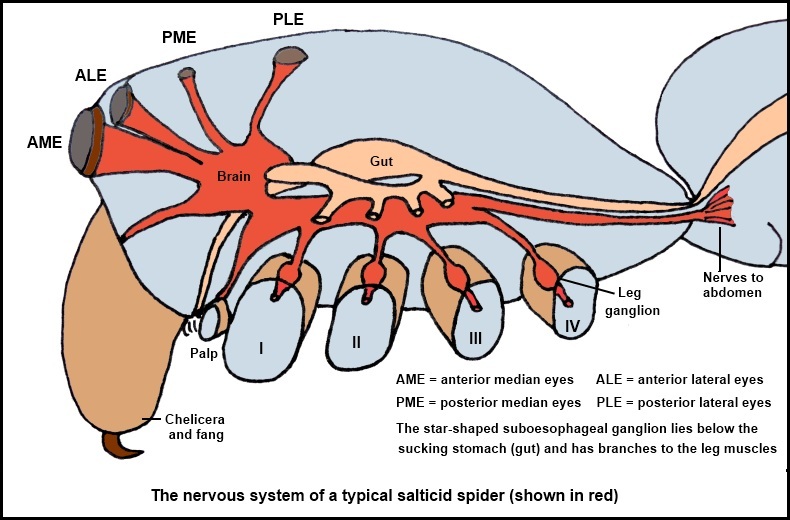
So what have we learned from salticids so far?  Well one thing we have definitely learned is that in spite of having a brain that would fit on the head of a pin with room to spare, salticids are actually quite capable learners.  In fact, research during the last few decades has shown that salticids are capable of learning from their mistakes in a trial-and-error fashion (Jackson & Wilcox 1993), learning to avoid many different kinds of noxious (unpleasant) stimuli (Skow 2006), and even how to take detours in order to reach a goal(Carducci & Jakob 2000).  If that list isn't too impressive sounding, think about how long it can take some dogs to learn a new trick; some spiders show learning after only 2-3 attempts!


This lovely diagram was borrowed from the "Find a Spider Guide."
 http://www.findaspider.org.au/info/spiderNS.htm


We have also learned that the environment a spider is reared in effects how it develops (Carducci & Jakob 2000).  While much of what has been learned from salticids is not directly applicable to humans, this particular finding is definitely applicable!  For example, using the findings from Carducci and Jakob's study, we can draw inferences about how the environment we raise our children in will effect their future mental development. Not bad for a little spider research!

This list of salticid (and spider) based contributions goes on but suffice to say, these little animals are teaching us quite a lot about our world and how things work within it.  My personal research on jumping spiders is about their ability to learn by watching each other.  While much of my work is still in progress, I can say that so far, they definitely seem to be among the handful of non-human organisms that are capable of learning this way.  Stay tuned for more updates!

31 October 2011

What does it mean to be a jumping spider?

Have you ever wondered what it means to be a jumping spider?  If you're like most people, then the answer is very likely no.  If, however, you are one of those rare souls who have pondered such a point, then I say good for you!  Either way, today's post will focus on jumping spiders and what makes them so special as a family of spiders.

First and foremost, as with many rules in science there are exceptions. Today, however, we will stick to the traits common to most jumping spiders.

Jumping spiders are unique in several ways, but our focus will be on the three biggest differences that set them apart from other spiders. These differences are:
  1. No webs
  2. Excellent vision
  3. Very smart
No webs
Unlike most other spiders, jumping spiders do not spin webs for prey capture, but rather hunt them like miniature, eight-legged cats.  They do still produce silk, and it is used in hunting, but not for prey capture.  Rather, they use the silk as a safety line, similar to a rock climber's rope.


Dragline and attachment point on glass. (Frank's Photo Essays)
The dragline ensures that when they jump, either after a prey item or to cross a gap, they have a backup if they miss.  Salticids also use silk to make retreats (the spider equivalent of a sleeping bag)
and for egg sacs, which are usually deposited in the females retreat.

Salticid in retreat. (Brisbane Insects and Spiders)


Excellent Vision
Jumping spiders have quite excellent vision which they use to find and stalk their prey.  They are able to see a broad range of colors, and some even in UV!  While they can see at a fairly high level of resolution, it is not quite as good as ours. Also, how they process things visually is a bit different from humans as well.  Here are two examples that might help you better understand their vision. Please bear in mind that the examples are only approximations.

Example 1:
Jumping spiders see a lot detail, but not as well as us.  If we see in 1080p, then a jumping spider sees what a normal television would display.  Compare the two pictures below, one in "Human vision" (High res) and one in "Spider vision" (Low res). 


"Human vision" vs. "Spider vision" (Borrowed from Wedding by Color)

Example 2:
To get all of the detail that they are able, jumping spiders sacrifice the speed of image acquisition.  In other words, when you look at a picture, you see it all  at one and process it almost instantly.  Jumping spiders, on the other hand, have to process things line by line.  I often use the comparison of a cable modem versus an old dial up 28k modem.  If human vision is high-speed internet, then jumpers are confined to the slow, but effective world of dial-up. 


Very Smart

Jumping spiders are able to do some very interesting and complex behavior considering their tiny size and even tinier "brains". Some of the more interesting things we've discovered these little predators can do include planning routes to prey items, trial and error learning, adaptive hunting techniques that vary based on previous experience with prey items, and my own research suggests that they are even capable of learning about something just by watching it.  Pretty amazing considering the brain of most of these little guys is smaller than the head of a pin!

So remember, the next time you see one of these fascinating little creatures, think twice before you decide that it needs to meet the bottom of your shoe.  The life you spare may just make your own more interesting